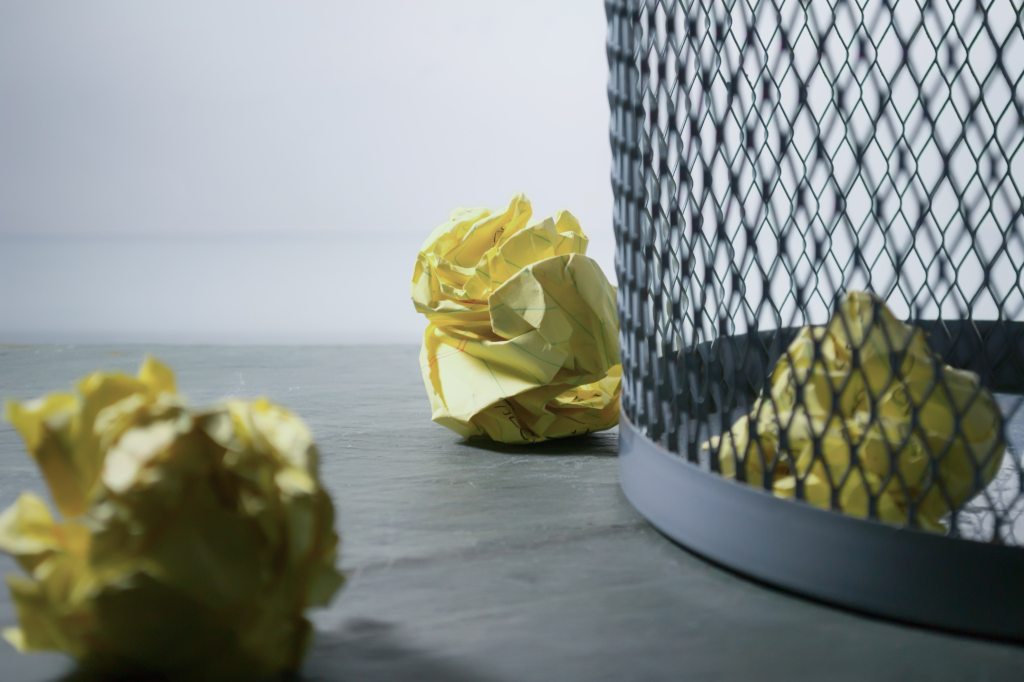
You’re about ready to quit. Give up. Throw your work-in-progress in the virtual trash.
Why should you even bother writing a book, anyway? You’re no good at this. Every sentence you read back feels like you’re trying too hard. What’s the point?
Have you ever had these thoughts? I have. Impostor syndrome aside, I often struggle to determine whether or not what I’m working on is “good enough” to even be considered for publishing.
The good news is, this is normal. No, seriously. At some point, every writer worries their words don’t make any sense.
Need some encouragement? Here it is: You might totally suck at writing at the moment. Or not. But that’s OK, because at some point along the way, we all do.
We all start out not really sure how storytelling works, at least beyond what we’ve read in books or seen on TV. Our stories are unoriginal. Our characters are flat. Our dialogue is so, so bad. And we don’t notice, because we’re just happy to be writing things — as we should be!
No one is born a good writer. Some people might learn related skills quicker than others. Some might have a more natural affinity for storytelling. But we all start at the same place: having absolutely no idea what we’re doing, but determined to throw caution to the wind and try our gosh darn hardest anyway.
Every once in awhile, I pull up things I wrote 10, 15 years ago. I read them, or at least start to. I cringe so hard my face hurts. And then I go back to what I was writing before, feeling a lot less doubtful about my ability to do good work.
Maybe you aren’t up for that kind of challenge (it’s a tough one, I don’t blame you). But do try to remember that it is nearly impossible to write as badly now as you did when you wrote your very first story, or journal entry, or poem. You have gotten better, even if it doesn’t seem like it. And you will continue to improve, as long as you keep writing.
So when you find yourself thinking, “I’ll never write anything as good as that,” remember that writer once thought that about the very thing you just read. And chances are, the first draft of what they wrote was a whole lot worse than what you see on that page.
The more we read and write, the more we’re able to recognize the difference between writing that’s “good” and writing that isn’t. Sometimes that even means we learn to recognize when our writing isn’t as “good” as we think it could be …
AND THIS IS A GOOD THING.
Realizing you can do better is the first step in figuring out how to do better. Maybe you don’t yet know how to make it happen, but you want to learn. That’s something!
If you’re on the same struggle bus I’ve ridden more times than I can count, hang in there. Try not to compare your work to someone else’s, especially if they’re published and you aren’t. They might be at a different skill level than you are, so comparing really isn’t fair.
Also, always keep in mind that even though patience is hard, it does pay off. Work at improving your writing a little bit every day (relatively), and you’ll eventually notice a difference.
We all start in the same place. Where we end up depends on how well and how much we’re willing to work to get to where we want to be.
Meg is the creator of Novelty Revisions, dedicated to helping writers put their ideas into words. She is a staff writer with The Cheat Sheet, a freelance editor and writer, and a 10-time NaNoWriMo winner. Follow Meg on Twitter for tweets about writing, food and nerdy things.


 Meg Dowell Writes
Compose your words of wisdom