
Trudging back to our English major roots today to discuss themes and motifs, concepts that can be confusing even if you’ve been writing for a large fraction of your existence. To add a little magic to the mix, we’ll use Harry Potter and the Sorcerer’s Stone to give you examples along the way.
First, let’s start with the difference between the two concepts.
A theme is a story’s overarching main point.
The theme of your novel, for example, is the main message you’re trying to get across to your readers, or the lesson your main character learns as a result of the book’s events. Basically, the theme is the reason you’re telling the story. In the first Harry Potter book, desire is a theme J.K. Rowling uses to convey the importance of maintaining control of one’s own wants.
An overall theme can be displayed through multiple plot threads within the same story, such as Harry’s desire to see his parents, Voldemort’s desire for the sorcerer’s stone and Dudley’s desire for, well … everything. But looking at the story as a whole, it’s the overall theme of desire that ends with Harry’s most significant character development.
Without Harry’s newfound understanding of this concept, it would be difficult to pinpoint why the rest of the events that took place at Hogwarts that year were significant.
It’s a theme’s ability to be present in multiple threads of the same tale that make it easy to confuse themes with motifs, so that’s where we’ll head next.
A motif is a smaller, recurring idea that can be linked back to your theme.
While your theme is your reason for telling a story—in our case, the basis of the lesson Harry learns by the end of the book—your motifs are the devices you use to tell that story so your character can get from start to finish.
Authority is one of Rowling’s many motifs in the first book of the Harry Potter series. We see the Dursleys take advantage of their authority over Harry at the beginning of the book. We see Dumbledore instill authority over many of the book’s characters, including Harry when confronted with the Mirror of Erised. And of course, Voldemort tries to establish his own sense of authority over Harry. That goes over quite well.
Let’s pay close attention to how each of these points links back to our theme of desire, which is what makes a motif so vital to its parent theme.
The Dursleys establish their authority over poor, undeserving Harry … but for the wrong reasons, because they desire power over him. And what happens? They lose that power the second Hagrid shows up. And just think of all the letters Hogwarts had to waste because of that desire for control.
Enter the Mirror of Erised (desire spelled backwards, just in case you never caught that). Dumbledore and Harry have a nice chat about desire, and socks, Dumbledore’s way of teaching Harry the lesson that leads right back to our theme—basically, be careful what you wish for (sort of). But remember when Dumbledore suggests Harry not look in our favorite mirror again? Boom. Instant authority. And not because he wants to boss Harry around, but because he wants the best for him (awww).
(Side note: the mirror itself, while a major contributor to this motif, is a symbol. We can talk about that later.)
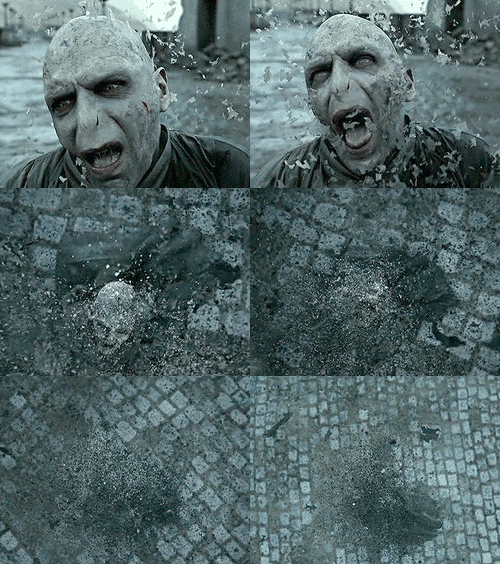
And Voldemort? Well, we all know why that didn’t work out.
Writing a story is like putting together a 90,000-piece puzzle without the picture on the box to guide you (dear God). It’s just a mess of pieces that don’t all seem to fit together at first. But if you’re a reader (and if you’re a writer, this shouldn’t be an issue), you know that, eventually, every plot point, every symbol, every motif eventually fits together under the same theme.
Eventually, all your ideas will come together, and they will make sense.
Always.
Images courtesy of Novelty Revisions, the Harry Potter Wiki and Pinterest.


 Meg Dowell Writes
Compose your words of wisdom